Bethesda news, restaurants, nightlife, events and openings, real estate, crime reports and more - the way only a lifelong Bethesda resident like Robert Dyer can bring it to you. Everything you want and need to know about Bethesda, plus special investigative reports you won't find anywhere else. The must-read blog for breaking Bethesda news, when you want to be the first to know.
Showing posts with label office market. Show all posts
Sunday, June 02, 2019
Bethesda construction update: Avocet Tower (Video+Photos)
Developer StonebridgeCarras broke ground this past week on their Avocet Tower office building project at the corner of Wisconsin Avenue and Montgomery Avenue, formerly the site of the 2nd District Montgomery County police station. It will be interesting to see if they can succeed where all other new Class A buildings have failed so far - none have been able to attract a major corporate headquarters. No major corporate HQ has relocated to Montgomery County in over twenty years.
Wednesday, August 15, 2018
Two Bethesda office buildings part of Brookfield securitization deal
Brookfield Property Partners has been criticized for carrying too much debt by some investment experts. The company also has office properties in moribund office markets like Montgomery County, also considered risky. Now BPP is placing several D.C. area properties into a $223.4 million securitization scheme through Morgan Stanley.
One Central Plaza and 6110 Executive Boulevard, both located in Bethesda, are part of the deal, as is 51 Monroe St. in Rockville.
Whether the move will ease critics fears of risk is unclear, however. Some argue that such deals themselves magnify risk, and obscure the equity the owner holds in the properties in question. Such securities were one of several factors that led to the "Great Recession" a decade ago.
One Central Plaza and 6110 Executive Boulevard, both located in Bethesda, are part of the deal, as is 51 Monroe St. in Rockville.
Whether the move will ease critics fears of risk is unclear, however. Some argue that such deals themselves magnify risk, and obscure the equity the owner holds in the properties in question. Such securities were one of several factors that led to the "Great Recession" a decade ago.
Thursday, July 13, 2017
JBG finds anchor for new Bethesda office tower...itself
The JBG Companies of Chevy Chase found a clever solution to leasing up its future 4747 Bethesda Avenue office tower in Montgomery County's weak office market - the development giant will move its own headquarters into the trophy Class A building in 2019. By that time, the company will have merged with another real estate powerhouse, Vornado/Charles E. Smith, and be known as JBG SMITH (NYSE: JBGS).
JBG's decision generated a sigh of relief among panicked County officials yesterday. So moribund is MoCo's private sector economy, that attraction of new corporations has given way to a desperate effort to retain the few flagship firms the County has now. So, much like Marriott moving down Old Georgetown Road in a few years, JBG's move is essentially reshuffling the deck chairs on the Titanic; Montgomery County hasn't attracted a major corporate headquarters to relocate here in two decades and counting.
The new JBG SMITH HQ will add 55 new jobs over its existing workforce. But the need to fill such an impressive building in such a prime spot again painfully disproved the MoCo political cartel's claim that corporations demand Metro access over highway and airport access, and walkable retail and restaurants in a mixed-use environment over suburban office parks.
4747 will be on top of not one, but two, Metro stations - the Red Line and future Purple Line. It will be surrounded by the successful and highly popular mixed-use retail, restaurants and housing of the Bethesda Row and Lot 31 developments. It will even have the trendy Dean & DeLuca attached to the building, in an already-built retail structure adjacent to the tower site.
Yet, much like 4500 East-West Highway, the building had no takers to be the anchor office tenant. If you had bought the arguments of Planning Board Chair Casey "What ex parte rules?" Anderson, et al that the new urbanist environment was the key to attracting business...your mind must be officially blown by this turn of events. No, Virginia, mixed-use is not the sole answer to MoCo's economic woes.
JBG is taking a hit to the pocketbook long-term to stay here in Montgomery County, a sacrifice County officials should thank them for profusely (did you know, for example, that electricity is 44% more costly in Maryland than in Virginia for businesses?). JBG is also commendably endorsing the urban, walkable environment it espouses itself with this move.
But County officials shouldn't dwell on their dodging of this latest bullet. They need to act, so that we can finally grow our economy, instead of sticking fingers into all the leaking holes that are increasing by the day. That includes reducing the County's massive taxes and exploding debt, building a new Potomac River crossing to Dulles International Airport, and completing our master plan highway system.
Rendering courtesy The JBG Companies
Monday, June 22, 2015
Report on MoCo's moribund office market offers the wrong solutions
It's not news to landowners, developers or readers of this blog that Montgomery County's office space market is as moribund as its economy. But the county's Planning Board is scheduled to be briefed on the dire situation during its meeting this Thursday, June 25. An advance copy of consultant Partners for Economic Solutions tells just how bad it is, and makes recommendations of what to do next. Unfortunately, it sounds like the report's authors are mostly telling County officials what they wanted to hear.
Some of the report's analysis and suggestions are off base. For example, one approach PES suggests is simply giving up on office space and converting it to residential. While developers and planners have already been taking that approach from Bethesda to Wheaton to Clarksburg, to continue on that path will generate a transportation disaster. Roads and Metrorail already overwhelmed by the current volume of commuters cannot handle a county where all the jobs are in DC and Virginia. Smart growth demands jobs be created, not vacated, across Montgomery County to reduce commuting distance. Instead, according to the report's data, MoCo planners and councilmembers have allowed 558,000 SF of planned office space to be canceled or converted to residential. And notes only a handful of the many planned projects and existing office spaces being converted to residential or canceled. We're literally becoming the DC area's ultimate bedroom community.
Secondly, the impact of telecommuting and shrinking office sizes are grossly overstated. The report attempts to partially blame those trends for vacant office buildings. But the same report acknowledges that the vast majority of jobs created in recent years are in retail and restaurants. You can't fold jeans or make a frappucino over the internet. There were no great numbers of private sector, high-wage jobs added in Montgomery County over the last decade. So you can't say telecommuting is the new normal when few of the new jobs can be done from home.
Thirdly, it also oversells the success of office space in high density urban areas within Montgomery County. While downtown Bethesda and Silver Spring indeed are desirable locations for employers, neither have attracted a major corporate headquarters in over a decade any more than the suburban areas of the county did. Wheaton is right on the Red Line as well, but is also a dead zone for office space.
If transit was the sole determining factor, Wheaton would be doing well. In fact, the report concedes this point on Page 40. It also notes that Wheaton and Glenmont are not convenient to I-270 and I-495, but fails to point out that two planned freeways (Rockville Freeway and Northern Parkway) that would have given both immediate access to the freeway system were canceled by the county decades ago. Whoops.
The report states - contrary to the current County Council's stated "transit-only" future, and its own final recommendations: "Subareas that can offer Metro and good roadway access within a walkable mixed-use environment will be the markets that recover most quickly."
Meanwhile, the Pike District of North Bethesda has been designed in the New Urbanism model for smart growth and walkable communities, and is on the Red Line as well. Yet it, too, has failed to attract a major corporate tenant. The only significant addition was a reshuffling of Bank of America/Merrill Lynch from Tower Oaks to Pike & Rose, which is simply rearranging the deck chairs on the Titanic. Strangely, the report claims a severe drop in the "White Flint" vacancy rate, without providing any data on what specific real estate and leasing moves account for their claim. Highly suspect.
If new urbanism and transit are so hot for employers, why is the Pike District utterly tanking for new corporate office space? Why are a gleaming new Class A office building at 4500 East-West Highway, and a revamped one at 7550 Wisconsin Avenue - both walking distance to the Bethesda Metro station, restaurants and nightlife - mostly vacant?
Finally, the report closes with a waving-the-pom-poms endorsement of the current County talking points for vibrant, walkable urban developments with transit, and infill development. That's great. But if you strip the corporate, government and government contractor jobs out of DC and Northern Virginia, guess what? They would both become ghost towns like the report claims single-use, auto-dependent suburban office parks are now in Montgomery County. All the window dressing and vibrancy in the world doesn't make a difference if you don't have any jobs or affordable housing for young professionals.
Yet the report suggest abandoning current and planned office space in places like Glenmont and the northern I-270 corridor. That suggestion is contrary to smart growth.
I'm not saying it isn't good to have great urban areas. We have them, and they are working well in many respects. But to claim that urbanizing the rest of the county is the magic solution to attracting jobs is disingenuous.
We have to look elsewhere to find the answers. The authors of the report have partially conceded this in briefly referring to road access. They've noted that more successful jurisdictions are offering better incentive packages. It costs too much to operate a company in Montgomery County and the state of Maryland. Gridlocked roads drive up the costs of labor and shipping, among other expenses. There's a reason you get charged your shipping rate by zip code - you pay more when you live in an area with congested roads.
And we need to target industries like defense and aerospace that are never going away. They happen to need the kind of larger square footage that the I-270 corridor and upcounty can provide - research labs and testing and manufacturing facilities won't fit in tiny urban footprints. The report does not even consider those types of employers, much less Fortune 500 companies, and buys into what our local elected officials and Wall Street crooks keep trying to sell the American people on - that the future is only in the "knowledge economy" and small companies. Wall Street outsourcers, Warren Buffett and China certainly are hoping you'll believe them.
Many parts of the report sound as if the writers had been briefed by County officials and politicians, rather than taking a completely detached and independent look at the situation. They should not be referring to the failed Nighttime Economy Task Force at all, much less praising its utter failure. Those apparent communications have tainted the objectivity of the report.
And nowhere does it mention one of the County's major traffic and economic development liabilities - the lack of direct access to Dulles International Airport. It's impossible to take seriously a report that doesn't talk about that at all. You know about the Nighttime Economy Task Force, but say nothing about the competitive disadvantage of lacking access to the preferred airport of international businesspeople and corporations?
Again, this suggests the research process was poisoned by political interference. "Don't you dare talk about Dulles Airport or new Potomac River bridges in this report, do you understand?"
There is a lot of valuable data in this report, but its final recommendations are too tailored to what the Montgomery County political machine and its developer patrons want to hear. A report that tells us to keep going the way we are currently going is not going to bring about change.
- Montgomery County's office vacancy rate has increased in the last year
- 11 county office buildings are nearly or totally vacant
- GSA could vacate 1.1 million square feet of office space in the county over the next 5 years, a devastating blow on the horizon
- Montgomery County's share of the total jobs in the region has steadily declined over the last 10 years, during which time no major corporation relocated to the county
Some of the report's analysis and suggestions are off base. For example, one approach PES suggests is simply giving up on office space and converting it to residential. While developers and planners have already been taking that approach from Bethesda to Wheaton to Clarksburg, to continue on that path will generate a transportation disaster. Roads and Metrorail already overwhelmed by the current volume of commuters cannot handle a county where all the jobs are in DC and Virginia. Smart growth demands jobs be created, not vacated, across Montgomery County to reduce commuting distance. Instead, according to the report's data, MoCo planners and councilmembers have allowed 558,000 SF of planned office space to be canceled or converted to residential. And notes only a handful of the many planned projects and existing office spaces being converted to residential or canceled. We're literally becoming the DC area's ultimate bedroom community.
Secondly, the impact of telecommuting and shrinking office sizes are grossly overstated. The report attempts to partially blame those trends for vacant office buildings. But the same report acknowledges that the vast majority of jobs created in recent years are in retail and restaurants. You can't fold jeans or make a frappucino over the internet. There were no great numbers of private sector, high-wage jobs added in Montgomery County over the last decade. So you can't say telecommuting is the new normal when few of the new jobs can be done from home.
Thirdly, it also oversells the success of office space in high density urban areas within Montgomery County. While downtown Bethesda and Silver Spring indeed are desirable locations for employers, neither have attracted a major corporate headquarters in over a decade any more than the suburban areas of the county did. Wheaton is right on the Red Line as well, but is also a dead zone for office space.
If transit was the sole determining factor, Wheaton would be doing well. In fact, the report concedes this point on Page 40. It also notes that Wheaton and Glenmont are not convenient to I-270 and I-495, but fails to point out that two planned freeways (Rockville Freeway and Northern Parkway) that would have given both immediate access to the freeway system were canceled by the county decades ago. Whoops.
The report states - contrary to the current County Council's stated "transit-only" future, and its own final recommendations: "Subareas that can offer Metro and good roadway access within a walkable mixed-use environment will be the markets that recover most quickly."
Meanwhile, the Pike District of North Bethesda has been designed in the New Urbanism model for smart growth and walkable communities, and is on the Red Line as well. Yet it, too, has failed to attract a major corporate tenant. The only significant addition was a reshuffling of Bank of America/Merrill Lynch from Tower Oaks to Pike & Rose, which is simply rearranging the deck chairs on the Titanic. Strangely, the report claims a severe drop in the "White Flint" vacancy rate, without providing any data on what specific real estate and leasing moves account for their claim. Highly suspect.
If new urbanism and transit are so hot for employers, why is the Pike District utterly tanking for new corporate office space? Why are a gleaming new Class A office building at 4500 East-West Highway, and a revamped one at 7550 Wisconsin Avenue - both walking distance to the Bethesda Metro station, restaurants and nightlife - mostly vacant?
Finally, the report closes with a waving-the-pom-poms endorsement of the current County talking points for vibrant, walkable urban developments with transit, and infill development. That's great. But if you strip the corporate, government and government contractor jobs out of DC and Northern Virginia, guess what? They would both become ghost towns like the report claims single-use, auto-dependent suburban office parks are now in Montgomery County. All the window dressing and vibrancy in the world doesn't make a difference if you don't have any jobs or affordable housing for young professionals.
Yet the report suggest abandoning current and planned office space in places like Glenmont and the northern I-270 corridor. That suggestion is contrary to smart growth.
I'm not saying it isn't good to have great urban areas. We have them, and they are working well in many respects. But to claim that urbanizing the rest of the county is the magic solution to attracting jobs is disingenuous.
We have to look elsewhere to find the answers. The authors of the report have partially conceded this in briefly referring to road access. They've noted that more successful jurisdictions are offering better incentive packages. It costs too much to operate a company in Montgomery County and the state of Maryland. Gridlocked roads drive up the costs of labor and shipping, among other expenses. There's a reason you get charged your shipping rate by zip code - you pay more when you live in an area with congested roads.
And we need to target industries like defense and aerospace that are never going away. They happen to need the kind of larger square footage that the I-270 corridor and upcounty can provide - research labs and testing and manufacturing facilities won't fit in tiny urban footprints. The report does not even consider those types of employers, much less Fortune 500 companies, and buys into what our local elected officials and Wall Street crooks keep trying to sell the American people on - that the future is only in the "knowledge economy" and small companies. Wall Street outsourcers, Warren Buffett and China certainly are hoping you'll believe them.
Many parts of the report sound as if the writers had been briefed by County officials and politicians, rather than taking a completely detached and independent look at the situation. They should not be referring to the failed Nighttime Economy Task Force at all, much less praising its utter failure. Those apparent communications have tainted the objectivity of the report.
And nowhere does it mention one of the County's major traffic and economic development liabilities - the lack of direct access to Dulles International Airport. It's impossible to take seriously a report that doesn't talk about that at all. You know about the Nighttime Economy Task Force, but say nothing about the competitive disadvantage of lacking access to the preferred airport of international businesspeople and corporations?
Again, this suggests the research process was poisoned by political interference. "Don't you dare talk about Dulles Airport or new Potomac River bridges in this report, do you understand?"
There is a lot of valuable data in this report, but its final recommendations are too tailored to what the Montgomery County political machine and its developer patrons want to hear. A report that tells us to keep going the way we are currently going is not going to bring about change.
Tuesday, October 28, 2014
4500 EAST-WEST HIGHWAY OFFICE BUILDING FINISHED, SIGNS FIRST TENANT IN BETHESDA
Carr Properties' new Class A office building at 4500 East-West Highway is now complete, including the public plaza outside, as you can see in these photos. I like the public art on the plaza a lot.
The developer also announced its first lease, after many months of struggling in Montgomery County's abysmal office market. It's not quite the prize that Intelsat would have been, as small business-financing firm RapidAdvance is simply moving from its existing Bethesda office to the new building. It will occupy a full floor at 4500, according to the Washington Business Journal.
After county officials fumbled Intelsat's interest in being the anchor tenant at 4500, the firm instead became the latest to choose Northern Virginia, with its friendlier business climate and Tysons' direct access to highways and Dulles International Airport.
Monday, September 15, 2014
PLAZA TAKING SHAPE AT NEW CLASS A OFFICE BUILDING IN BETHESDA (PHOTOS)
Carr Properties' 4500 East-West Highway Class A office building was designed to include a public plaza at the corner of East-West and Pearl Street. That plaza is now beginning to take shape. It could help not only as an amenity for future workers there, but also to attract a restaurant tenant to the building's ground floor.
The nearly-finished office project remains without any tenants as of this writing. I actually found an old story which revealed that one of Montgomery County's most recent fumbles in attracting a major corporation involved this building. Instelsat S.A. was scouting potential new homes for its headquarters, then located in the District off of Connecticut Avenue. According to the article, the firm seriously considered the 4500 East-West building, but ultimately opted to go to Northern Virginia. Instelsat is now the anchor tenant in Macerich's impressive Tysons Tower, Fairfax County's first billion dollar property.
Other tenants at Tysons Tower include Deloitte Consulting, which leased 88,000 SF.
In addition to the higher cost, and less-friendly business environment of Montgomery County, traffic congestion and lack of direct access to Dulles Airport were obviously factors, as well. Intelsat's CEO, David McGlade, specifically cited "a first-class transportation system" as one of the company's must-haves in choosing a new headquarters. Tysons Tower has direct access to the Capital Beltway, the new 495 Express Lanes (which are only on the Virginia side of the Beltway), and the Tysons Corner Metro station. In the near future, the building will have direct rail access to Dulles Airport, when the Silver Line is extended there.
Access to the Bethesda Metro station is one of the major advantages 4500 East-West has going for it. But as anyone who drives in downtown Bethesda knows, traffic is a nightmare, as is trying to reach the Beltway from here during rush hour. Driving to here from Dulles Airport or vice-versa? Fuhgeddaboudit!
The nearly-finished office project remains without any tenants as of this writing. I actually found an old story which revealed that one of Montgomery County's most recent fumbles in attracting a major corporation involved this building. Instelsat S.A. was scouting potential new homes for its headquarters, then located in the District off of Connecticut Avenue. According to the article, the firm seriously considered the 4500 East-West building, but ultimately opted to go to Northern Virginia. Instelsat is now the anchor tenant in Macerich's impressive Tysons Tower, Fairfax County's first billion dollar property.
Other tenants at Tysons Tower include Deloitte Consulting, which leased 88,000 SF.
In addition to the higher cost, and less-friendly business environment of Montgomery County, traffic congestion and lack of direct access to Dulles Airport were obviously factors, as well. Intelsat's CEO, David McGlade, specifically cited "a first-class transportation system" as one of the company's must-haves in choosing a new headquarters. Tysons Tower has direct access to the Capital Beltway, the new 495 Express Lanes (which are only on the Virginia side of the Beltway), and the Tysons Corner Metro station. In the near future, the building will have direct rail access to Dulles Airport, when the Silver Line is extended there.
Access to the Bethesda Metro station is one of the major advantages 4500 East-West has going for it. But as anyone who drives in downtown Bethesda knows, traffic is a nightmare, as is trying to reach the Beltway from here during rush hour. Driving to here from Dulles Airport or vice-versa? Fuhgeddaboudit!
Wednesday, March 26, 2014
WITH LARGE FIRMS STEERING CLEAR, MONTGOMERY COUNTY LOWERS EXPECTATIONS ON OFFICE LEASING
AKRIDGE DIVIDING FLOOR
INTO SMALLER SUITES
IN BETHESDA; SPACES
QUALIFY FOR NEW
COUNTY SUBSIDY
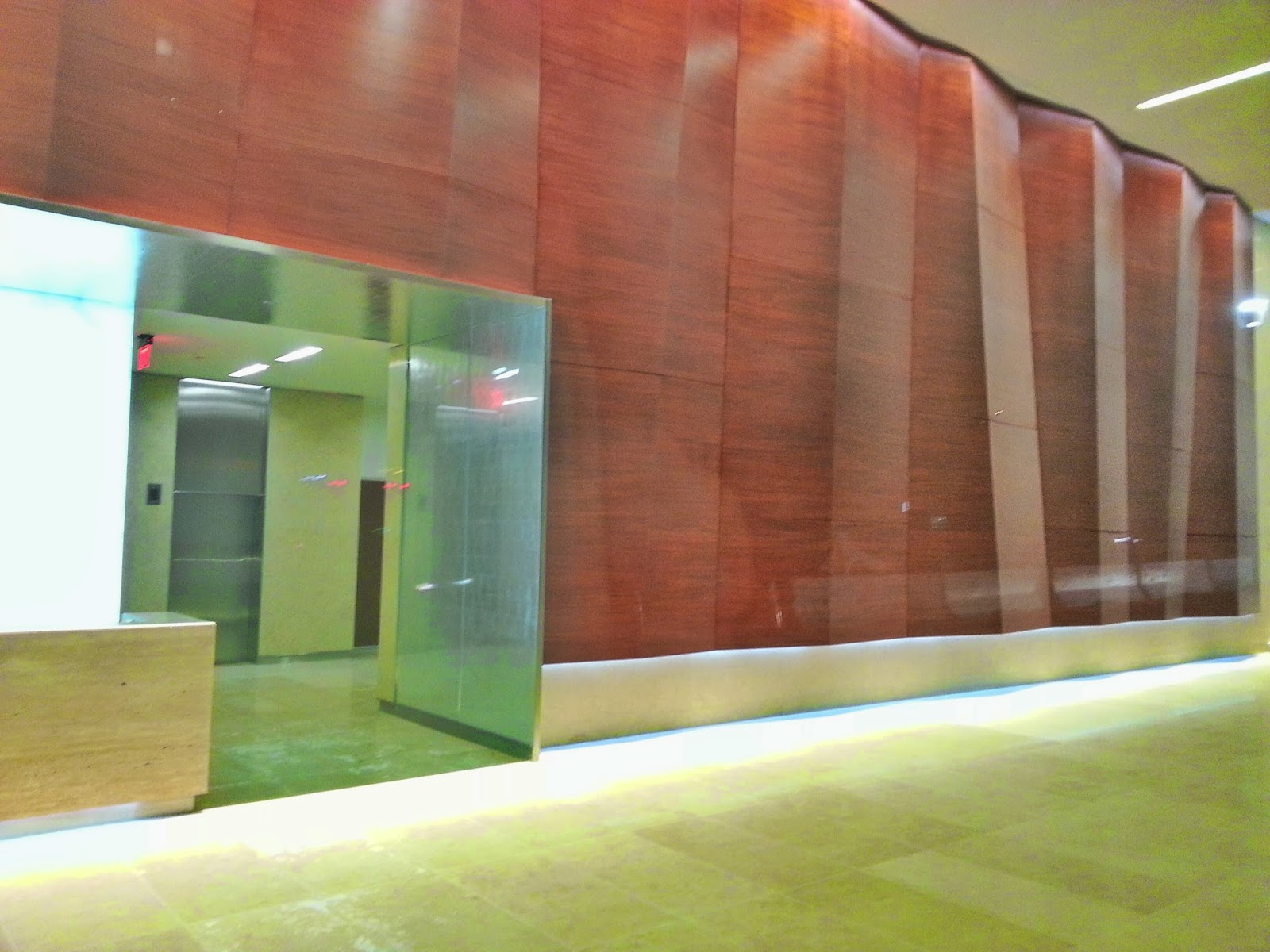
The gleaming building at 7550 Wisconsin Avenue, that was completely renovated into a Class A office tower by developer Akridge, was poised to become a hot business address. 18 months later? It's a vacant monument to a business climate that fails to appeal to major firms searching America for a new corporate headquarters.
With no significant policy or taxation changes on the horizon, no plans to build a new Potomac River crossing for the Dulles Airport access international firms demand, and landlords having to still pay their bills while vacant, some are now thinking small.
Montgomery County's Economic Development Fund is now offering a program designed to attract smaller firms to vacant office space in the county. The MOVE program will offer $4-per-square-foot rent subsidies to a first-time renting firm that meets 4 criteria. Spaces that qualify are limited to those between 2,000 and 10,000 square feet.
Akridge is ahead of the downward curve in Bethesda.
The company is currently in the process of dividing the fourth floor of 7550 Wisconsin into 3 suites - on spec, as there are still no tenants. But going forward, those new suites would likely qualify for the new MOVE subsidy. There are still many other floors in the building, however. According to a source, Akridge is open to dividing other floors into suites, if the initiative proves successful on the fourth floor.
Subscribe to:
Posts (Atom)


_1.jpg)

_1.jpg)


_1.jpg)


_1.jpg)

_1.jpg)