Showing posts with label Uber. Show all posts

Tuesday, April 10, 2018

MoCo Council bill would divert funds for the disabled, seniors to BRT slush fund

After voting to tax Uber rides to subsidize failing Barwood Cab, which ended with Barwood filing for bankruptcy anyway, now the Montgomery County Council is trying to convert funds the tax earmarked for seniors and the disabled into a slush fund it can use for the $10 billion Bus Rapid Transit boondoggle. Bill 13-18, sponsored by Council President Helpless Hans Riemer, would strip all language from the Uber tax that directed funds to transportation for the disabled, elderly and poor, and "instead allow use of the fund for any transportation purpose in the County."

We already knew that the Uber tax, as I warned in my testimony opposing it, would hurt County residents and Uber drivers alike. Exactly as I predicted, Uber rides became more expensive, Uber drivers are being paid less than they were a few years ago, and no new ride-sharing competitor has entered the Montgomery County market since the tax was imposed.

This also made the County less appealing to the young professionals the Council has tried to publicly claim they wanted to attract, as millennials overwhelmingly use Uber rather than taxicabs. To our stuck-in-the-60s Council, diesel buses and Barwood Cab are still considered state-of-the-art transportation.

But now the Council is adding insult to severe economic injury to the County. When passing the Uber tax, the bleeding-heart language related to improving transportation for the disabled and elderly was used by the Council in the media as a fig leaf, to cover the anti-progress, fight-the-future nature of the Uber tax.

Now the Council is cravenly plotting to steal the money out of the hands of the disabled and elderly, and use it to fund their struggling $10 billion BRT boondoggle. The County, currently facing a $208,000,000 budget shortfall, has been unable to find enough funds for the BRT scheme. They failed to create an independent transit authority twice, which would have had unlimited power to tax and spend with no oversight by any elected official. Recently, they tried and failed to have their allies in Annapolis give them "quick-take" land seizure authority, which would have allowed them to seize homes and businesses - not only for the demolitions BRT will require along each route, but which could also have been sold to generate more money for the unfunded BRT boondoggle.

Desperate for money, the greedy Council will now try to pry it from the hands of disabled, poor and elderly residents, and put it into the pockets of themselves and their developer sugar daddies, whom the whole BRT scheme was dreamed up to profit.

It's outrageous.

It's bad enough Uber and Lyft riders have had to pay more, and via the tax pay Barwood Cab even if they weren't using their services. But to then find out the Council used the disabled and seniors to actually gain a new revenue source for their BRT boondoggle, this is a new low for even this corrupt Council.

Thursday, December 22, 2016

Barwood files for bankruptcy after MoCo Council charged you to subsidize it

"If it moves, tax it. If it keeps moving, regulate it. If it stops moving, subsidize it."
- Ronald Reagan

SPECIAL REPORT: Abuse of the system

The Montgomery County Council proved yet again why term limits were supported by nearly 80% of their constituents this week, when the dinosaur taxicab company it tried to preserve for the last year using your tax dollars filed for Chapter 11 bankruptcy. Barwood Cab announced the filing yesterday, about 18 months after the Council gave the company several regulatory breaks, and charged Uber users and taxpayers to subsidize changes that would help it compete with Uber and Lyft.
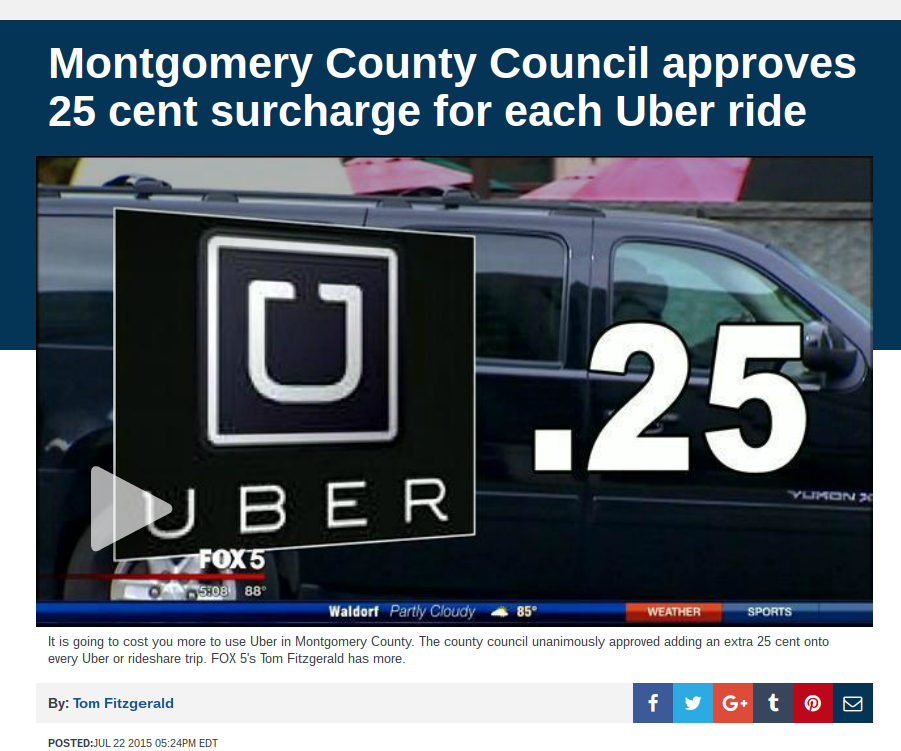
Fox 5 News
The private-sector entrepreneurs who created Uber and other ride-sharing services spent years and many thousands of dollars developing the mobile apps that brought them so much success. Barwood and other taxi monopolies around the country could have invested in and implemented such apps years ago, if they wished. They didn't.

What did the Montgomery County Council do? They charged their constituents and Uber new taxes and fees to fund the creation of what they claimed would be a hip, new Barwood app - a.k.a. "a centralized dispatch system" - at YOUR expense.
Montgomery County Council
generously using your money
to help Barwood Cab
"Compete With Companies
Like Uber," NBC4 reported
NBC4
The laws passed also gave numerous, money-saving breaks to Barwood that weren't in the public interest, such as allowing them to use older vehicles longer (not exactly a move to increase service reliability, as your mechanic might be able to tell you), relax meter standards and color requirements, and allow sublicensing and temporary identification cards for taxicab companies - which are not ride-sharing services like Uber, and therefore were supposed to be more regulated.

Fact is, the Council was once again caught "fighting the future," trying to drive the very ride-sharing services their constituents now choose over the Stone Age taxicab out of the county.

Who were the lead faces behind Barwood-subsidizing Uber taxes...er..."taxicab reform?" Councilmembers Roger Berliner (who once had the owner of Barwood serve as his County Council campaign treasurer) and - surprise! - Hans Riemer. Once again, Councilmember Riemer has proved every initiative he takes on will end in complete and utter failure.

Ending the County liquor monopoly? I'll give you a few minutes here, to roll around on the floor with laughter. After claiming with great media fanfare that government had no business running the liquor business, Riemer ended up ramming through a proposal that would preserve the dinosaur liquor monopoly at the expense of taxpayers, and restaurant and bar owners. It was such a great proposal that his own Democratic colleagues in Annapolis tore it up and threw it in the trash upon its arrival. Riemer has since endorsed numerous variations on the theme - solutions that preserve government control, while charging new taxes to subsidize that monopoly. Nice.

Food trucks? Riemer's own political operative, who was appointed to a $150,000 County position, was put in charge of "helping food trucks." The changes he and Riemer implemented resulted in 96% of food trucks going out of business, or retreating back into the District. A handful remain, which operate only on private property.

Cybersecurity? Riemer promised in 2010 to make MoCo a "cybersecurity hub" on the east coast. Four years later, it was exposed that the county government was running on Windows 2000, perhaps the most insecure platform in the world. Six years later, a State audit revealed critical cybersecurity weaknesses in Montgomery County Public Schools' computer network. These flaws put private student information a few clicks away for hackers, and gave access to the entire MCPS network, including log-in passwords for personnel. Yikes.

Jobs? Riemer was given a friendly platform by the faux-conservative Washington Examiner in 2012 to announce he was going to do something about the county's "sluggish job growth." Results? Four years later, Riemer's own former chief of staff criticized the county's "stagnant" private-sector economy, which remains moribund. The County continues to experience a net loss in private-sector jobs since 2000, including a loss of 2000 retail jobs, according to the Maryland Association of Retailers. Not one single major corporation has moved its headquarters to Montgomery County in two decades. Ouch.

Hans Riemer made himself the public face of a snow removal law that cost County taxpayers $6 million, for his own publicity purposes and political gain. Then winter hit, and snow remained unshoveled in front of properties owned by wealthy developers, and more embarrassingly, by Montgomery County itself! To cap off the humiliation, Riemer and his council colleagues rode past the snow piles multiple times on a tourist bus tour of the Westbard area, and after seeing the unshoveled sidewalks, still took no action. Best of all, in recent weeks, Riemer has put himself forward in the media again as the "snow guy." Oh, boy, is this winter going to be fun.

Changes ahead for Barwood? They will paint their cabs black (in fact, they've already started doing so), and will use iPads for payment. The former would eliminate the one branding element they've been known for. As for the latter - why would you want to deal with somebody's dirty public iPad, when Uber lets you use your own phone for the entire transaction, including receipt? Talk about the stone age.

After the "success" of using their constituents' money to boost Barwood Cab, what's the next venture for Riemer and the Council? They're going into the banking business!

That's right. The seemingly endless number of banks all around us are no longer enough. Berliner is going to start his own bank - with your money. How generous! Local businesspeople will go to the Bank of The Montgomery County Council and get a loan. They represent a risk that real, private banks won't take on. But that's not a problem at the Council's bank - because it's your money they'll be doling out, not theirs.

You won't even get a lollipop.

Monday, July 18, 2016

MoCo Council crackdown on airbnb reinforces County's anti-business, "fight-the-future" reputation

Anti-business Montgomery County
Councilmember Hans Riemer
When Montgomery County Councilmember Hans Riemer declares he has found a new sector of the economy to fix, businesspeople are justified in heading for the hills. After chasing 96% of food trucks out of the County (or out of business altogether), running 9 bars and a 24-hour restaurant out of business in Bethesda with his "nighttime economy" initiative, and spearheading a "get government of the liquor business" drive - that ended with Riemer endorsing the County government monopoly on liquor, where to next for Hans Riemer?

Well, after Riemer and his Council colleagues finished raising your Uber fares in Montgomery County, they're now fighting another modern upstart in the cutting-edge "sharing economy" sweeping the nation: airbnb.

County residents found a wonderful business opportunity in offering their properties for short-term rental on airbnb. They dared to have some success and make money, without help or involvement from Montgomery County Government. And that's sure to run you afoul of the Montgomery County political cartel.

As with Uber, Lyft and other ride-sharing services, the Council has their Communist China-style doublespeak ready to deploy. They are actually "legalizing airbnb," if you read their taxpayer-funded propaganda regarding the bill and zoning text amendment. Most people struggling to pay the bills and get the kids to school on time will hear that, shrug, and keep going.

Here's what they're really doing:

First, folks in the County have found a relatively simple and easy source of revenue through airbnb. So the MoCo cartel has to figure out A) how to eliminate this business opportunity, or at least make it difficult and complicated enough that "the masses" (a.k.a. the little guy) will be discouraged from engaging in it; and B) how does the MoCo cartel get a cut of the money?

The answer is very similar to their agenda with Uber. Apply a new tax. Make Uber more expensive to use. Make doing business here more costly for Uber, thereby driving up Uber fares and driving down another new economic opportunity, driving for Uber. Less drivers adds to the pressure for higher fares, and Uber becomes less appealing to use for those with less money. And "the little guy (or gal)" who thinks of a way to disrupt Uber with his or her own ride-sharing innovation now can't get into the market, because the entry cost is higher than it was when Uber and Lyft got in. Mission accomplished, and they sold it as "legalizing Uber."

Now, it's airbnb's turn. A public meeting will be held tonight to seek feedback on the airbnb crackdown. You can RSVP online.

Riemer, et al, have pointed out with glee that they are so inept (the County government was found to run on Windows 2000 four years after Riemer took office), that they passed a zoning code in 2014 that made airbnb "illegal."

Montgomery County is not enforcing the supposed rules that "banned" airbnb. In fact, a search on the airbnb website for rentals available for this coming weekend in Bethesda and Chevy Chase alone shows 26 listings. Those include a bargain $38 airbed available on Westbard Avenue. There are 30 listings in Silver Spring, including a "cheerful, serene" room near Forest Glen for $39.

Those prices are for check-in Friday through check-out Sunday. For the traveler who can't afford an overpriced hotel room, that's a huge deal. That also ticks off the County political cartel.

So, if successful, the Council will double-tax airbnb "landlords" by forcing them to pay both income tax and a hotel tax, a law already passed by the Council last year. Now they'll add a new "tax," which they're calling a license, and which must be renewed annually.

In addition, airbnb entrepreneurs would only be able to rent their primary residence. The bill also contains a stipulation that "County officials" (and the language leaves open that it could be any County official, if designated by one of three officials named in the bill) have the right to enter your property at any time for any inspection "they may deem necessary." Finally, the bill demands that the property owner maintain a guest register like a hotel, with personal information on each airbnb guest, that the County can review at any time.

With the hotel tax and register, once again the Council is treating one type of business as another. They successfully forced ride-sharing services under the same rules as taxicabs, a completely different business model. Here, they're attempting to reclassify airbnb rentals as hotel rooms, or bed-and-breakfasts.

And once again, the cutting edge of business and technology is going to be blunted by our "Fight the Future" County Council. Across the country, entrepreneurs, venture capitalists, and other businesspeople seeking to launch start-ups are paying attention to the follies of our elected officials.

They're finding Montgomery County to be an expensive and complicated place to do business. That hurts businesspeople, and it hurts consumers. We get less choices. Prices go up. Opportunities and jobs continue to go elsewhere.

What are we missing out on under the "leadership" of Riemer and our current Council?

Global revenue from the "sharing economy" is forecast to reach $335 billion by 2025, according to PricewaterhouseCoopers. Even the famously-liberal City of Takoma Park isn't cracking down on airbnb.

Message? If you want to start a disruptive tech company, don't start it in Montgomery County. With an already-moribund private sector economy, and billions in wealth fleeing to neighboring jurisdictions, that's a message we literally cannot afford to send.

Tuesday, April 05, 2016

Montgomery County Council still fighting the future, Uber and Lyft

The Montgomery County Council crackdown on ride-sharing services like Uber and Lyft, which not only raised your fares but dings you 25 cents on every Uber trip you take, isn't over yet. New WMATA chief Paul Wiedefeld and the members of the WMATA board of directors will meet with the Council today at 12:45 PM. But last week, seven councilmembers sent a letter to Wiedefeld demanding he not partner with Uber or Lyft on paratransit services.

Instead, the council wants to not only extract that 25-cent Uber tax you're paying on each ride now, but also want you, the taxpayer, to subsidize - guess who - Barwood cab, the Council's idea of cutting-edge transportation. Like in D.C., cab companies would handle paratransit services beyond what MetroAccess provides.

Term limits are gaining steam thanks to the Council's disregard for residents' concerns about development from Lyttonsville to Chevy Chase to Westbard. Unlike paratransit, there will be an app for that.

Wednesday, December 03, 2014

PAST FIGHTS FUTURE AT MONTGOMERY COUNTY COUNCIL HEARING ON UBER, LYFT, TAXIS

One day after Montgomery County Executive Ike Leggett and County Council President George Leventhal exhorted the Council to disprove the widespread perception that the county is hostile to business... the Council held a public hearing on a bill hostile to business.

Council Expedited Bill 54-14 would, plain and simple, make it more costly for ridesharing services like Uber and Lyft to operate in Montgomery County. If passed, it would absolutely, positively raise fares for users of Uber and Lyft. And the bill sends a terrible message to the region and the nation that Montgomery County is closed for business.

Beyond punishing ridesharing services, subsidies were on the table for Uber and Lyft's competition, the local cab companies. Specifically, Expedited Bill 55-14 would require the county's Department of Transportation to create a "centralized, electronic taxicab dispatch system" - at taxpayer expense. Likewise, Expedited Bill 53-14 would reduce the cost of operations for Barwood and other cab companies, while 54-14 raises the cost for Uber and Lyft. Sound fair to you?

Considering that's there is no mass public outcry to put more regulations on Uber and Lyft, where is the urgency for ham-handed government intervention coming from? If you haven't already figured it out, Barwood is well-connected politically in the county. Uber and Lyft entered a stagnant transportation market, did well, and now its taxi competitors are crying foul. Using political connections and hiring at least one PR firm, they have attempted to create a fake Astroturf campaign against ridesharing companies. Which Bill 54-14 incorrectly lumps in with taxicabs.

Uber and Lyft are not taxicabs. While they operate legally in the transportation market, and indeed have some advantages over taxicabs, they cannot - for example - troll the streets, hotels and shopping centers of Montgomery County, in hopes of being hailed by a prospective passenger. That's an advantage taxis have over ridesharing.

While some on the Council are hoping to preserve the status quo of the old taxi monopolies their constituents have been complaining about for decades, the rest of the world has shifted beneath them. I attend a fair number of grand openings and events around Bethesda and the county, and I can't recall anyone arriving by taxi for the red carpet. 

Young people, in particular, are arriving by Uber. One topic receiving a lot of press in the last year has been the question of how to attract more millennials to live and work in Montgomery County. The County Council has been one of the prime talkers on this issue. Their record doesn't back up their talk. Affordable housing is being torn down, no major corporation with high-wage jobs has been attracted to the county in over a decade, and the county even managed to run 90% of food trucks out of downtown Bethesda. 

Now Bill 54-14, which would raise Uber fares, and some councilmembers' threats to crack down on increasingly popular e-cigarettes, are raising the volume on a clear message to millennials - Montgomery County is not for you. Imagine millennials' reaction to the County Council making their Uber rides more expensive.

But back to business - If I'm the CEO of a tech start-up, and I know that, once my product disrupts the established powers in the market, the Council will step in and crack down on me - why would I incorporate my business in Montgomery County? And why would I offer my product or service to county residents, if the elected officials will make that product or service more expensive (and therefore less competitive) to please established companies that have a direct line - and checkbook - to the County Council?

This isn't just about Uber and Lyft. Ideally, wouldn't you like to have additional ridesharing services competing for your travel dollar in the county? Upstart competitors won't just be hurt by Bill 54-14, but may be shut out entirely from our market. Uber and Lyft are big enough to simply pass the added costs 54-14 would impose on them onto their customers; start-ups won't have the customer base and financing to do that.

More evidence of the ground shifting beneath the County Council? Major corporations like Citigroup and Gannett have made Uber the official ground transportation option for their employees, instead of taxicabs. If you're the CEO of a Fortune 500 company, and you know Montgomery County will raise the travel costs for your firm, why would you be encouraged to relocate your headquarters there, or do business there?

Not to mention that the crackdown on Uber will suggest to those corporations that Montgomery County's leaders are stuck in the past and fighting the future, hardly the message you want to send to the tech, aerospace, defense and biotech industries.

Uber and Lyft are at least as safe as taxicabs, and offer more accountability and convenience than traditional taxis do. We need more of these services, not less, and certainly not higher fares. If Barwood and other taxi services would like to switch to becoming a ridesharing service, they can do that without public financing and subsidies.

Ridesharing services are also creating jobs and providing transportation to areas of the county underserved by transit.

In emotional testimony last night, Uber driver Elgasim Fadlalla said the company "saved my life." Laid off in a recent round of Pentagon defense cuts, Fadlalla has been able to attend school while driving for Uber. As a former taxi driver, he said that would not have been financially feasible if he were driving a traditional cab. With a taxi company, "I owe them $105 for rent when I wake up in the morning." Not so with Uber.

Another Uber driver, Dario Arana, said he owns 12 restaurants in the DC area, in addition to his driving job. He drives to help people more than just for the money, he said. "Public transportation here in the county is not reliable, and we definitely need ridesharing companies" to augment that system, he testified.

Reliability is also critical for Uber user Bridget Frances, who said, "I've found Uber quicker than Metro, and more reliable than the bus. It's the most convenient thing. I don't know what I did before Uber."

Isn't it time Montgomery County stops fighting the future?

Wednesday, June 26, 2013

UBER EXPANDS BETHESDA SERVICE

Uber DC, an increasingly popular alternative to taxicabs, has just announced it is expanding service in the Bethesda area.

The company says the expansion will cover all of Bethesda, from Bethesda Row and nearby residential neighborhoods, to Congressional Country Club (sounds like the best way to travel to the golf tournament).

Average wait times should now be 10 minutes, which makes Uber even more competitive versus other taxi and sedan services.

Thursday, October 11, 2012

AVOID WEEKEND METRO FAILS WITH NEW BETHESDA TO DC NIGHTLIFE SHUTTLE

DC HOPPER JOINS
UBER - WILL PRIVATE
TRANSPORTATION
REPLACE
PUBLIC TRANSIT?

Another Robert Dyer @ Bethesda Row Exclusive

Are you sick and tired of using the Metro Red Line on weekend nights?  Delays, single-tracking, breakdowns, and - my personal favorite - total closure of the Bethesda Metro station - even on a holiday weekend?

There's a new option.

The DC Hopper, a "nightlife shuttle," launched in Bethesda this past weekend.

You can board the Hopper at the corner of Norfolk and St. Elmo Avenues, across from Hanaro.  Just check the schedule, go to the Hopper stop, pay by credit card (or even with your phone - they accept Square payments!), and even while they're processing your credit card, you're already on your way into DC.

The Hopper will take you to - and bring you back from - Georgetown (1218 Wisconsin Avenue NW) and Dupont Circle (18th Street and Connecticut Avenue NW).

But wait, there's more!

You'll also get a wristband that entitles you to VIP line access and discounted drinks, among other perks.  Participating clubs include Modern, Dirty Bar and Third Edition.

This service is being specifically marketed as an alternative to the poor-performing Metro system, just as private car service Uber has offered a high-quality alternative to taxis.

We know Metro is a public system.  But taxis are so over-regulated by local governments, that they have essentially become public transportation, as well.  What Uber has started, is a textbook demonstration of the power of free markets and competition.

You provide a terrible service?  Well, guess what?  I don't have to use your service!  This other guy is going to provide a better product, and that's who is going to get my money.

Is there any surprise that some on the DC Council want to stop Uber?

It makes you wonder about the future of transportation.  I think Metro was great, and could be great again with the right leadership at WMATA and regionally.

But to keep making the public pay more for service and quality that consistently gets worse - we can't go on like this.

Services like DC Hopper and Uber suggest that, unless public agencies and elected officials clean up their act soon, we might witness a revolution in private transportation.   Paper card?  Smart card?  Who needs a card, when your smartphone summons and pays for the whole thing!

This is a positive development, and ultimately, government will have to compete or give up in the transportation marketplace.