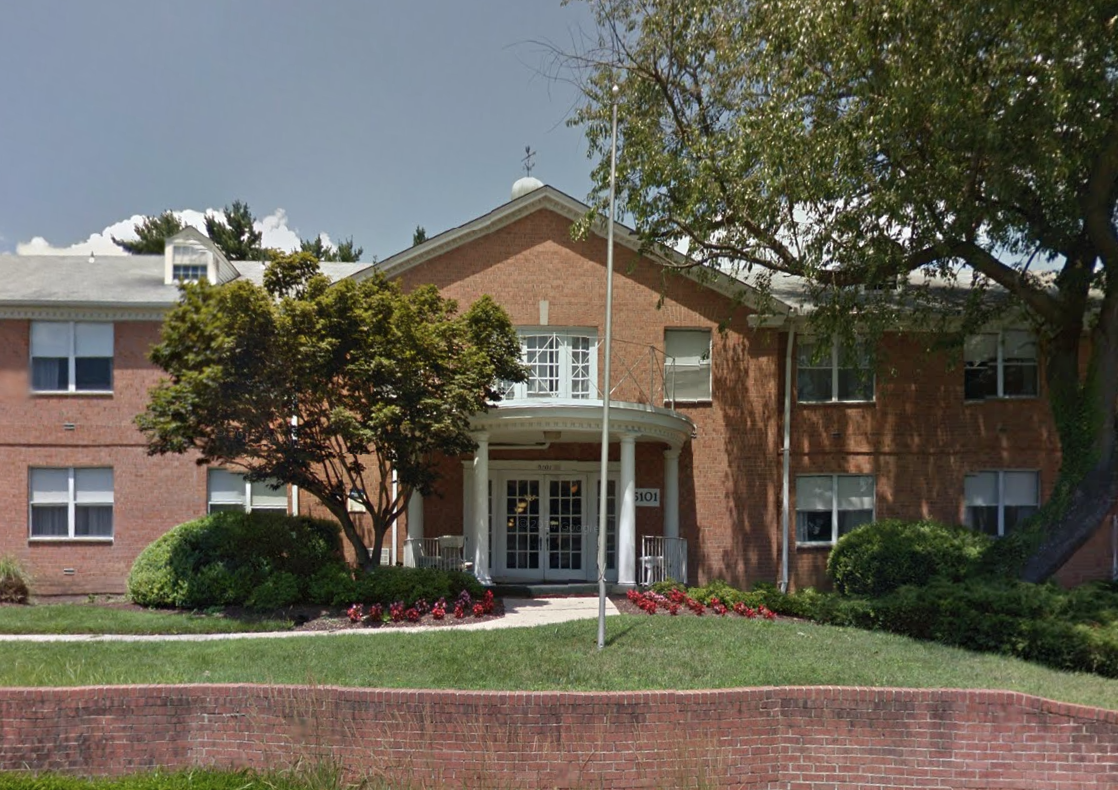
Developer Equity One gave its first indication of a specific plan for the properties it recently acquired in the Westbard area of Bethesda at a Design Principles presentation, held at Walt Whitman High School last night. Equity One's Executive Vice President of Development, Michael Berfield, led the presentation. A question and answer session followed.
This was a far more productive meeting than the initial design workshops. The venue and parking, in contrast to those events, were ample. While Equity One is still holding much close to the vest, there was a specific overview diagram of a possible plan for the entire suite of properties, known as the Westwood Complex. And Berfield took questions from the audience. Some at the initial meetings felt their voices were not heard. At last night's meeting, every person who wanted to ask a question was allowed to speak, and the meeting was extended beyond the expected end point for that purpose.
Berfield's presentation started well enough. He promised to make every effort to retain the small businesses that currently constitute the majority of tenants within the Westwood Shopping Center. Equity One plans to enhance those local retailers with national brands. Many people in the room had different interpretations of what that meant.
Some expressed opposition to the potential for big box stores; Berfield responded that in his daily work, that definition is not always determined by the square footage of a store. He and other company representatives gave examples of high-end stores that have large footprints, while also suggesting that there simply won't be the square footage needed for a Best Buy or Walmart on this site.
Historically, during the golden age of the Westwood Shopping Center, it was a retail center dominated by national and regional brands. Farrell's, Radio Shack, Baskin Robbins, Crown Books, Drug Fair, a hardware chain and others leased there prior to the 1990s; Radio Shack remains, and Rite Aid replaced Drug Fair. Much like in Wheaton, Glenmont, Kensington, and other areas of the county, the lure of rezoning was dangled by county politicians funded by developers. Landowners began to dream of a day when shopping centers could be mixed-use mini-cities. Suddenly, solid brand-name tenants in these commercials areas began to move out, as landlords implemented rates and terms that would position them well for a quick demolition, when the new zoning passed.
Alas, it took about 30 years to accomplish the zoning change, passed just this year by the Montgomery County Council. In the meantime, small businesses filled the spaces that weren't allowed to stay vacant. Now tenants like Anglo Dutch Pools and Toys, the venerable Westwood Barber Shop, and Beyda's Lad And Lassie have become old standbys for local residents. But the changes coming have some tenants "quaking in our boots," according to one who attended last night's meeting.
Berfield said Equity One will not demolish the existing Westwood Shopping Center first; such a move would leave the firm with no income during construction, he noted. But the plans make such a demolition all but certain eventually.
An urban "Main Street" is the "Westbard Vision" for Westbard Avenue, a heavily-traveled commuter route during rush hours twice daily. A rendering showed an urban, Bethesda Row-style streetscape of shops and cafes. Equity One representatives said their goal is to improve the safety and ambiance for cyclists and pedestrians along the street. The intersections at Ridgefield Road and Massachusetts Avenue have always been challenging to cross. Montgomery County's Department of Transportation recently installed all-new signal apparatus in all directions at the Ridgefield intersection, but have not activated it yet. Whether this will be an improvement won't be clear until they do, but I'm assuming that was the point of the new equipment.
Yet the Equity One plan, and the idea of an "urban boulevard" along Westbard are at cross purposes. The plan calls for a major influx of new residents, and an undetermined increase in retail and restaurant traffic. Meanwhile, the firm's traffic expert says they will implement various methods of slowing down drivers. Unfortunately, that is a formula for traffic disaster not only on Westbard during rush hour, but on already-nightmarish River Road. It simply cannot be done.
What really stood out for me at last night's meeting, was the size of the residential component. Most of the communication from Equity One tends to emphasize enhancing the retail experience. I'm on board for that, and I think many others are, too. There hasn't been a real, sit-down, family restaurant in the Westbard sector since Farrell's closed in the mid-80s. Given the income level of the surrounding neighborhoods, the current dining situation is as improbable and absurd as it gets. Yet the landlord previous to Capital Properties and Equity One was determined to wait it out with no restaurants. So one or more restaurants would be welcome, in my personal opinion. There's room in the parking lot (especially over in the unused one currently zoned as residential) to add retail and restaurants. And I was one of dozens in the room who applauded one resident's suggestion of Wegman's (if Giant were to decline to renew its lease in 2017).
So there's a lot of room for Equity One to come up with a fantastic design for a new retail center, with the existing services already there, and some national retail and restaurant brands that would really benefit the neighborhood. It would be profitable. But not as profitable as the residential-heavy plan Equity One appears to be pursuing.
A giant, atomic crab is going to land on the Westbard Sector. At least, that's what the Equity One rendering suggests:
 |
The Giant Atomic Crab
that will land on Westbard |
The colors remind one of those satellite images that confirm dense cities generate more heat than green suburbs. That's appropriate, given the urban character being proposed for this currently-suburban area.
Nothing is final about this plan. Equity One is perfectly sensible in not getting too specific, as no one can predict what the real estate market - or economy - will be like by the time they're a few years into this massive project.
But the design principles shown make residential surprisingly dominant. Surprising, for two reasons: First, the type of high-density residential that is certainly on the table is exactly the type that will generate traffic and school congestion. If Equity One selects that route over the "world-class retail center" alternative, it will be actively seeking confrontation with public school parents and residents. With 6 trailers outside, WoodAcres simply can't hold this many students. And if you're one who buys the bunk that families with kids don't live in apartments, I urge you to go by Westbard when school buses are circulating twice a day. You'll find a sizable crowd of students from the existing multi-family buildings on Westbard.
The diagram shown could literally double the population of the nearby neighborhoods now. Equity One has introduced local development firm EYA as a new partner in the redevelopment. EYA builds high-density, multi-family housing. Based on the document shown above, one can expect apartment buildings of some height, where the existing parking lot is now above the Westwood Shopping Center. And possibly some townhomes on the edges of that property, where it meets garden apartments, single-family homes, and Westland Middle School.
What's shown as "mixed-use" where Bowlmor, the two Citgo stations, and the Westwood Center II are today, will surely be apartment towers with retail on the ground floor. There is no demand for office space in Bethesda, or anywhere else in the county right now. And the "residential" area on top of the Springhouse by Manor Care nursing home property would almost certainly end up as an EYA townhome development. Notice how the red extends in a strip west along River Road, behind single-family homes on Westbard. That must be the odd property acquired by Equity One a few months back, which has a River Road address.
The potential total number of units is enormous, when you add all of those potential projects together.
Here's the really odd part: Equity One specializes in retail and shopping centers. That is their area of expertise. Residential development is not something they are known for. But when the giant atomic crab design made the large residential component really stand out, I had to ask Berfield about this during the Q and A.
I mentioned that, in my review of the company's large portfolio, I had not found another project with heavy residential development like the one being proposed for Westbard. Could he point to a similar project the company had successfully managed of this type, or is this endeavor an entirely new frontier for Equity One?
Commendably, Berfield was totally candid in his answer. He said this is a very unique project for the firm; they have done nothing comparable to this in the past. And, he added, that is why they are bringing EYA on board.
There are a couple of problems there. First, if Equity One hasn't done this before, what if they make mistakes during this new venture that cause the whole project to collapse when it is halfway finished? Doesn't this make a high-income residential area, in effect, a guinea pig for a novice in the urbanization field? After decades of neglect by the county, there is little room for error in the redevelopment of the Westbard Sector.
Second, EYA was the firm that was able to essentially take over a portion of Little Falls Stream Valley Park, build a bridge over a stream, and extend a road into the park. And made misleading statements regarding its community outreach leading up to the approval of that luxury townhome project. In a nutshell, the company met with the Citizens Coordinating Committee on Friendship Heights and a local stream advocacy group, and then cited their support as representing the entire community. In fact, many of those individual communities were never consulted. Neither of the two groups I mentioned had any legal authority to negotiate on behalf of residents in neighborhoods adjacent to the project. Confronted well into the process by a constituent at a town hall meeting, County Councilmember Roger Berliner said he had never even heard of the proposal.
The resulting project has turned out just about like I testified it would at multiple hearings before the Planning Board, NCPC, and a county hearing examiner. A formerly uninterrupted stretch of Little Falls Parkway now has a street jutting out, and the massing of the townhomes asserts itself into the park to a greater degree than the factory they replace. In my opinion, the county should have acquired the Hoyt property to convert it to parkland, as a stream buffer.
EYA would do best to follow the example of Equity One on this project, and have these sort of high-profile community meetings.
Conversely, despite my opposition to that project, in my personal opinion, EYA may have the best townhome designs in the DC region. If you look at their portfolio, they don't just generate the same cookie-cutter townhomes you find elsewhere; each project has a distinct design. Some have been tailored to fit existing historical neighborhoods in the District; others create a new, original community, such as at Potomac Place.
But the bottom line is that the concept suggested will entirely change the character of the existing neighborhood, which theoretically, no sector plan or project should ever be permitted to do. A doubling of resident population would not only flood roads and schools, but also reduce the political power of the existing residents in future decisions.
Parking is sure to be a problem as well. There doesn't appear to be room for any significant surface parking for the Westwood Shopping Center. People don't choose to live in the suburbs to spend time in dungeon-like parking garages. Those are simply inappropriate for a green, residential area, whether the parking is free or not.
Parking problem No. 2: Buildings and townhomes without adequate parking will lead to residents, and guests, parking in the adjacent neighborhoods. That will be used by politicians as a convenient excuse to introduce permit parking in those neighborhoods, gouging residents with expensive permits that rise in cost with each additional vehicle registered, as in anti-car DC. That is completely unacceptable, intolerable, and a total non-starter.
I would urge Equity One to scale back the plan, and put greater emphasis on retail and restaurants, as well as having distinctive architecture and retaining the suburban, residential character that surrounds this neighborhood commercial center.