Showing posts with label Rockville Pike. Show all posts

Monday, May 26, 2025

Strong-arm carjacking in Bethesda


Montgomery County police responded to a report of a strong-arm carjacking in Bethesda early Saturday evening, May 24, 2025. The assault and carjacking were reported in the 8800 block of Rockville Pike at 6:59 PM Saturday. That is in the vicinity of the Medical Center Metro station, and Walter Reed National Military Medical Center. 

Sunday, January 22, 2017

Rockville Pike lane closures Tuesday by NIH/Walter Reed in Bethesda


Expect single lane closures in both directions on Rockville Pike (MD 355) in Bethesda on Tuesday, January 24, between 10:00 AM and 2:00 PM. The closures will be in the block between Jones Bridge Road and Cedar Lane, in front of NIH and Walter Reed.

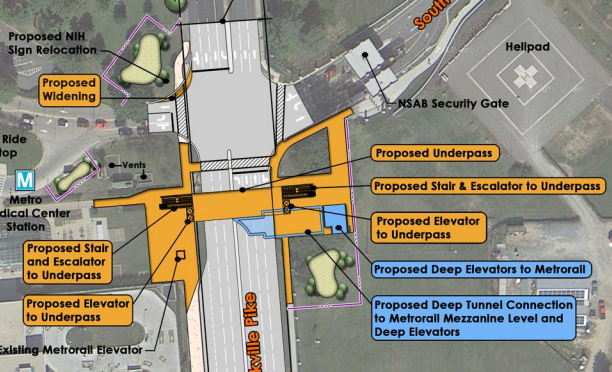
This is related to the project that will build a tunnel underneath the Pike, and high-speed elevators down to the Medical Center Metro station on the east side of the state highway.

Monday, June 23, 2014

STAPLES CLOSES IN WHITE FLINT (PHOTOS)

Staples has closed its White Flint location at 11503 Rockville Pike. The shopping center's other tenant, Casual Male XL, remains open - for now. Saul Centers, Inc., owner of the retail center, plans to demolish the building for a mixed-use development. A sign is directing customers to the Staples at 1531 Rockville Pike. The building itself actually looks new and modern; it would have been a good space to put an upscale restaurant, or large retailer. Oh, well.


Casual Male XL is still open

Sunday, March 23, 2014

MID-PIKE PLAZA MAIN BUILDING NOW WALLED OFF IN WHITE FLINT (PHOTOS)

The Dark Side of White Flint, Part 25

Welcome to The Dark Side of White Flint, an ongoing series about the not-so-wonnerful, wonnerful, wonnerful side of urbanizing the suburbs of Montgomery County.

The end is nigh for the venerable strip mall structure at Mid-Pike Plaza, which is currently being transformed from a suburban shopping center into a small-scale urban city. Toys R Us had moved within the center from its legendary spot on the south end; in January, it closed altogether. Now the remaining businesses in the structure are gone, and no public access is allowed - only construction vehicles.

A separate, free-standing retail structure with Starbucks remains accessible on the property.

Here for history, and posterity, are some of the final moments, images and memories of this classic Montgomery County shopping center. Mid-Pike Plaza was born decades ago, when it and Montrose Crossing were prime real estate along the future route of the DC Outer Beltway. Later, the Outer Beltway (a.k.a. I-370/Intercounty Connector) route was moved north, and the interstate's right-of-way was designated as the future Rockville Freeway.

Property owned by the Maryland State Highway Administration that was set aside for an off-ramp from the Rockville Freeway onto southbound Rockville Pike (MD 355) remains visible on records and blueprints for the new development that is replacing Mid-Pike Plaza. Of course, the county failed to build the Rockville Freeway, as well. The Montrose Parkway was built using some of the Rockville Freeway's right-of-way, but does not have the more-effective cloverleaf interchange needed to provide the maximum traffic congestion relief.

E.J. Korvette was a tenant from the early days, a department store chain that rose to prominence along with the American suburbs, as cities declined. Korvette's was the Walmart of its time, undercutting prices of its traditional retail competitors. There is a reference to Korvette's on many old documents for Mid-Pike Plaza, as well. This was before my time, but it makes me wonder if the whole site originated as a Korvette's? And, what year did Korvette's close? Is it possible I was just too young to remember it? If you know the answers, please leave a comment below!

For now, we prepare to say farewell to a classic shopping center on the busiest commercial strip in the state of Maryland. Though it falls at the hands of urbanization, it will not be forgotten.

I'll conclude with the words of Bill Shakespeare:

“But let it be. Horatio, I am dead;  
  Thou livest; report me and my cause aright
  To the unsatisfied.”


Monday, December 30, 2013

TOYS R US TO CLOSE IN JANUARY AT MID-PIKE PLAZA ON ROCKVILLE PIKE (PHOTOS)

STORE WON'T
REOPEN ELSEWHERE

The Dark Side of White Flint, Part 19:

Welcome to The Dark Side of White Flint, an ongoing series about the not-so-wonnerful, wonnerful, wonnerful side of urbanizing the suburbs. These articles provide "the rest of the story" about redeveloping White Flint not found in rosy local media reports.

A Christmas shopping visit to the downscaled Toys R Us store on Rockville Pike brought disappointing, if expected, news: the store will close for good sometime next month, according to a store employee. Worst of all, the store is not relocating; it is the end for Toys R Us here. Having split my childhood toy purchases between this location, and the also-demolished Lowen's toy store in downtown Bethesda, this conclusion is certainly a sad one for me. The original Toys R Us structure was already demolished on the other side of the shopping center; this store is essentially a pop-up affair, but still had a decent inventory. As Toys R Us winds down from its final Christmas shopping season, a closing sale is offering modest discounts of 10-30%. Under the sale's terms, there are no refunds or returns. Shelves throughout the store are increasingly bare, and most are not being restocked.

The anti-suburbia activists will say this is no big deal, "change happens, deal with it," and that urbanizing strip malls on Rockville Pike will reduce exhaust emissions. All three arguments are false.

There is no equivalent toy store anywhere in the Bethesda or Rockville area. Furthermore, Toys R Us carries multiple toy lines exclusive to its stores. Having come directly from the nearby Target, I can confirm that the selections are quite different. And when the Toys R Us was fully stocked, there was simply no comparison between the stores. I am a big fan of Target, and shop at several of their stores frequently. But they understandably cannot devote the space or depth to toys that Toys R Us can, given the broader merchandise array of a big box store. The loss of convenience and toy merchandise selection is indeed a "big deal" for downcounty residents.

Change may happen, but in this case, the desire of parents and children to buy toys has not changed. Development decisions cannot be made in a vacuum, but must take into account the needs of current residents, and the general economic best interest of the area. There is no convincing argument for the destruction of a successful commercial area like Rockville Pike. And even less logic behind one that then banishes the longtime businesses whose stores are demolished. Change in Montgomery County today is primarily driven by development interests, even when other business interests are damaged in the process.

Finally, urbanization of White Flint and Rockville Pike is leading to more driving, not less. The patrons of demolished businesses astronomically outnumber the future residents of luxury buildings in the area. When that Hallmark ornament cannot be found in White Flint, or that Toys R Us-exclusive toy must be had for Christmas, shoppers don't deprive themselves - they hit the road. And now their shopping trip burns several times the amount of gas. So we've made our community less convenient (unless your life revolves around $100 restaurant dinners and high-end shopping 365 days a year), and increased auto emissions, to boot.

In what is becoming a "disposable society," there are costs. Welcome to the dark side.

More articles in this series:

White Flint Mall demolition, phase one (Photos)

Phase one demolition continues (Photos)

The Cheesecake Factory goes dark at White Flint Mall (Photos)

Wednesday, June 12, 2013

ROAD RESURFACING IN WHITE FLINT (PHOTOS)

Rockville Pike (MD 355) is currently being resurfaced between Montrose Parkway and Nicholson Lane. You may encounter grooved surfaces and uneven roadway along this segment, as well as traffic delays.

Friday, May 17, 2013

MONTGOMERY COUNTY BRT PUBLIC HEARING AT PLANNING BOARD

Apparently, some opponents of the proposed Montgomery County Bus Rapid Transit system are big fans of American Idol and/or The Office.

The ratio of BRT fans to opponents was much closer at last night's Montgomery County Planning Board public hearing in Silver Spring than it was at the first public hearing last summer.  This time around, developer-backed groups turned out more speakers than last July, when opponents dominated the debate.  The meeting was certainly poorly advertised.

But the arguments remained the same.

Proponents, and certainly, developers, want the development BRT will allow, and the pain it will cause drivers.

One problem is, the type of community they want Montgomery County to be is not necessarily what a majority of taxpaying residents want. The idea that a small faction can impose itself on the majority, and in a winner-take-all fashion, is simply contradictory to not only the founding principles of America, but to reality itself.

In my testimony, I urged the Planning Board to put the Transit Corridors Master Plan in the context of the county as a whole. They are the county planning body, not the White Flint planning commission.

And we have to run the numbers - the real-world numbers.

With limited transportation money, and an indefinite structural budget deficit, we can't afford to waste money on a bus system that will worsen congestion.

For example, the Metropolitan Washington Council of Governments' American Legion Bridge study showed that 23% of Maryland drivers using the bridge are headed to the Dulles area.

What that means in real terms, is that a new Potomac River bridge via the unbuilt Rockville Freeway or I-370 would reduce Legion bridge traffic by nearly a quarter. BRT proponents' most Fantasy Island projection of congestion relief, by contrast is 15%. The contrast speaks for itself, especially when the BRT system under discussion will cost $5 billion.

But let's examine that BRT traffic "relief" using real numbers, not Planner Larry Cole's fantasy numbers.

Rockville Pike is currently 70% over capacity.

The draft plan takes 2 lanes from the Pike, reducing vehicular capacity by 33%.

Okay, now we're 103% over capacity.

Now, pretend that the wildest, most fantastical BRT projection came true, just for the sake of argument: Under that dreamy scenario, 15% of drivers "get out of their cars" and start commuting by bus.

That brings us down to 88% over capacity on Rockville Pike.

So, we've spent $5 billion, and increased road rage, and pollution through idling car engines, and...

...traffic is now 18% worse than if we had done nothing!

Does this make sense to you?

Anyway, the majority of turnout last night was from Bethesda, Chevy Chase, and Silver Spring.

Civic associations from Woodmor-Pinecrest, Locust Hill, Bethesda Crest, Chevy Chase West, and Chevy Chase Valley expressed serious reservations about the plan as drafted.

The Montgomery County Sierra Club, the City of Takoma Park, Indian Spring Civic Association, Hillandale Civic Association and Greater Colesville Civic Association were in favor of the BRT plan.

Michelle Riley of the Woodmor-Pinecrest association said her neighborhood will be the most-affected residential area in the county, if BRT goes forward. Riley said the system makes little sense for Woodmor, as the major traffic is related to the Beltway, not the routes targeted for BRT.  She also warned of property seizures below New Hampshire Avenue.

Locust Hill and Chevy Chase West shared concerns about losing already-limited neighborhood access due to BRT lanes and turn restrictions.

The Bethesda Crest HOA noted that BRT would eliminate an existing Forest Conservation Area along their community.

While Tony Hausner of Indian Spring supports BRT, one position I do share with him is that zoning along BRT routes should not be changed. Of course, such protection will never be extended to existing residents, as redevelopment of the Georgetown Square and Wildwood Shopping Center are just two of the secret developer objectives with BRT. The others, of course, are to build cities in the country at Science City and Olney, as well as Burtonsville.

There were some 1984-esque arguments made by the Sierra Club. First, that BRT will reduce emissions. That is patently false. BRT could well be powered by fossil fuels. No one has committed to clean fuel buses.  Secondly, it is a scientific fact that traffic jams actually increase smog and vehicle emissions. BRT will worsen congestion by 18-33%, at a minimum. Meaning up to 33% greater pollution in Montgomery County.

They also repeated Rollin Stanley's old line, "They're coming." This refers to armies of new residents who are en route to live in Montgomery County in the coming decades. This is complete bunk as well.

Our population can only grow as much as our Planning Board and County Council allow it to. We have absolute control over our own destiny - and density - despite the theatrically-panicked claims of developer-backed politicians and citizens.

Finally, the Sierra Club parroted a popular developer talking point: "More young people are not using cars. They prefer high-tech."

Yeah. Okay.

As this plays out in hipster urbanization journals, kids are forgoing cars so they can have iPhones instead.

I'm assuming the Sierra Club hasn't seen the "Cars of GW" slideshow that went viral online. For a less elite example, visit the Montgomery College parking lot in Rockville at 11:00 AM. I rest my case.

Oh,  and those coveted smartphones the kids are "saving up" for? Anyone who has attended a movie recently knows that parents buy these phones for kids long before they can even get a license.

And I'd like the anti-car elites to tell us if their $70000-to-start jobs have "must have own transportation" as a requirement in the job announcement?

Get out in the real world with working people and find out what it's like, and why cars are often a necessity. There's a reason why a Baltimore non-profit gives low-income single moms cars so they don't have to use transit anymore. Time and access to more employment opportunities equals more income.

I was glad to see Debra Alfarone of WUSA9 covering the hearing last night. This story has been under-the-radar too long.

One sentence of my testimony ended up in the 11:00 news report.  In light of the need to move over a million people in Montgomery County, and the anti-car arrogance of the draft BRT corridor plan, I said "an anti-car attitude at this point is counterproductive."

I couldn't have said it better myself.

Thursday, April 11, 2013

MONTGOMERY COUNTY BRT WOULD TAKE 13-21% OF ITS RIDERS FROM METRO ALONG 355, PLANNER SAYS

Montgomery County Planning Department Master Planner Larry Cole told the Rockville Planning Commission last night that a bus rapid transit line along MD Route 355 would take "13-21%" of its ridership from Metro.

Why is this important?

For two reasons. First, it highlights the duplication of existing subway service by BRT. In fact, Commissioner David Hill questioned Cole on that very point at last night's briefing at Rockville City Hall.

Secondly, it confirms my argument from the beginning of this sham of a process regarding BRT:  the duplicative service will attract mostly those who already use transit. In the process, it will slash the already insufficient revenue of the Metro system.

Where will that shortfall be recovered from? From you and I, the taxpayers. And again from you and I, in the form of future Metro fare increases.

It begs the question again - if the county has a magic $5 billion in extra revenue to pay for the BRT system, wouldn't that money be better spent on projects that will actually reduce congestion? These would include M-83 Midcounty Highway Extended, the Rockville Freeway, a new Potomac River bridge, expanded MARC service, the Purple Line and an extension of Metro to Gaithersburg and Germantown.

In contrast to those projects, the ridership, density and demand numbers for BRT simply don't add up.  With no solid evidence that drivers will "get out of their cars," it's safe to assume Metro ridership will be the target audience for the Emperor's New Bus, thereby providing no congestion relief.

What could ultimately end up happening, is a small BRT ridership, taken in even greater numbers from Metro than Cole's projections suggest, riding $5 billion buses along a now even-more-congested Route 355. And Metro in even worse financial straits than ever.

Rockville Planning Commissioners were understandably skeptical of Cole's presentation.

Commissioner Jack Leiderman asked Cole if he was attempting to "punish" drivers by removing 2 car lanes from 355 for BRT. Cole arrogantly responded that drivers "don't own" those lanes.

Mr. Cole, those of us who live in Maryland not only own those lanes, but we paid for their construction, and continue to pay for their maintenance.

Cole made the mistake of comparing the seizure of 2 lanes for BRT to HOV Lanes on I-270. Anyone who actually drives on 270 knows that the HOV idea was a complete failure, and does continue only as a punishment for drivers. The HOV lane is that one which you turn to the left and see hardly anybody in, while you're crawling or at a complete stop on 270. Not only is traffic still jammed, but you're moving even slower, thanks to the loss of 25% of capacity in the Express lanes.  And during rush hour, many HOV drivers are using the lane illegally.

Cole wasn't done making odd comparisons.

When a skeptical Commissioner Dion Trahan quizzed Cole as to how losing already-jammed lanes would reduce gridlock, Cole referred to Ballston in Arlington.

Cole repeated a popular urban myth among "smart" growth advocates, that traffic on Wilson Boulevard in Ballston and Clarendon has actually decreased, despite massive, dense redevelopment.

This is an apples to oranges comparison, and complete bunk. First, the "less traffic" argument is hardly accurate as it relates to Arlington.

But, more importantly, there is no comparison whatsoever between Wilson Boulevard and 355.

The daily traffic count on Wilson is around 15,000 vehicles.

The daily traffic count on Rockville Pike is 43,000 to 46,000 cars.

Wilson is a lower-capacity road than 355.

And Wilson is not an arterial road of the scope of 355.  355 carries heavy traffic from Washington, Frederick, Carroll and Montgomery counties along a corridor that has only one alternative, 270.

In contrast, drivers traveling west-east into Washington through Arlington have many parallel routes to choose from.  Rockville Pike is not Wilson Boulevard, and you can't make it so just to satisfy ideology or developers.

Speaking of which, Cole seems to favor both. Cole's recent suggestion to kill the grade-separated Montrose Parkway certainly revealed an anti-highway, pro-developer bias. That's not a good starting point for a planning department that is supposed to ensure adequate mobility of citizens via a multimodal transportation system.

But there's more ideological dreaming, "behavior-modification" scheming, and development cheerleading going on than planning in Cole's department.

Asked by the commission's chair, Jerry Callistein, why no planning has been done for BRT parking, environmental studies, BRT-Metro transfers, BRT vehicle storage, etc., Cole essentially responded that the dog ate his homework. It's hard enough to get the BRT plan passed without worrying about those little details, Cole suggested.

Unsatisfactory answers were the rule in a presentation on an unsatisfactory boondoggle of a BRT proposal.

Monday, March 25, 2013

MONTGOMERY COUNTY BRT TASK FORCE CHAIR'S DEVELOPER TIES REVEALED

WINSTON STANDS TO PROFIT FROM LOCAL DEVELOPMENT PROJECTS, WHILE ADVOCATING BRT-RELATED DEVELOPMENT

The public relations disasters for Montgomery County Bus Rapid Transit advocates just keep on coming.

Among the most memorable were the revelation that the BRT vehicles would move 15 miles in 50 minutes.

And that Communist Chinese officials were advising the county government on the development of its BRT system.

Just last week, the Montgomery County Planning Board sent planning staff back to the drawing board, after Master Planner Larry Cole and others produced fictional BRT data that was not even close to real-world accurate.

Cole also tried out this whopper: he said traffic volume on area roads will increase 70%.  The solution? Cole recommended reducing current highway capacity by 33% on roads like Rockville Pike, by turning already-jammed car lanes into bus lanes.

Let's add that up, folks:  to handle volume increase of 70%, reduce capacity by 33%.

Huh?

These people not only need a calculator, but also some spray-tan.  Because they obviously don't get out very much. Here's the real world numbers, Mr. Cole: at 4:00 PM last week, it took me an hour to drive from Bethesda to Rockville Town Center. The Pike was crawling, and lights were not synchronized, contrary to government statements otherwise.

You're going to make that 33% worse?

One secret driving force behind BRT has been that land along the BRT routes will be eligible for taller, denser, urban-style development. Whether anyone rides the Emperor's New Bus, or not.

Now a Washington Post article has revealed BRT Task Force Chair L. Mark Winston's ties to development interests.  According to the Post, Winston stands to profit from local transit-oriented development projects. Hmm.  Sound familiar?

But wait, there's more!

Winston's law firm, Glazer Winston, is all about real estate development. On its website, Winston's firm touts the following:

"In its Real Estate practice, the Firm represents local, regional and national real estate owners, developers and investors in the acquisition, development, financing, leasing and sale of office and industrial properties, retail shopping centers, apartment projects, hotels and raw land."

Isn't this a conflict of interest, to chair a commission pushing a pro-development agenda that you could also profit from, if successful?

What lands around the county might Glazer Winston have a financial interest in, now or in the future?

The final irony?

Winston - a fervent advocate for the rest of us to get out of our cars, and take the bus - says "it has been a while" since a rode a bus himself.

Classic Montgomery County elite hypocrisy. Smart growth, transit-only advocates should take the medicine they prescribe for everyone else.